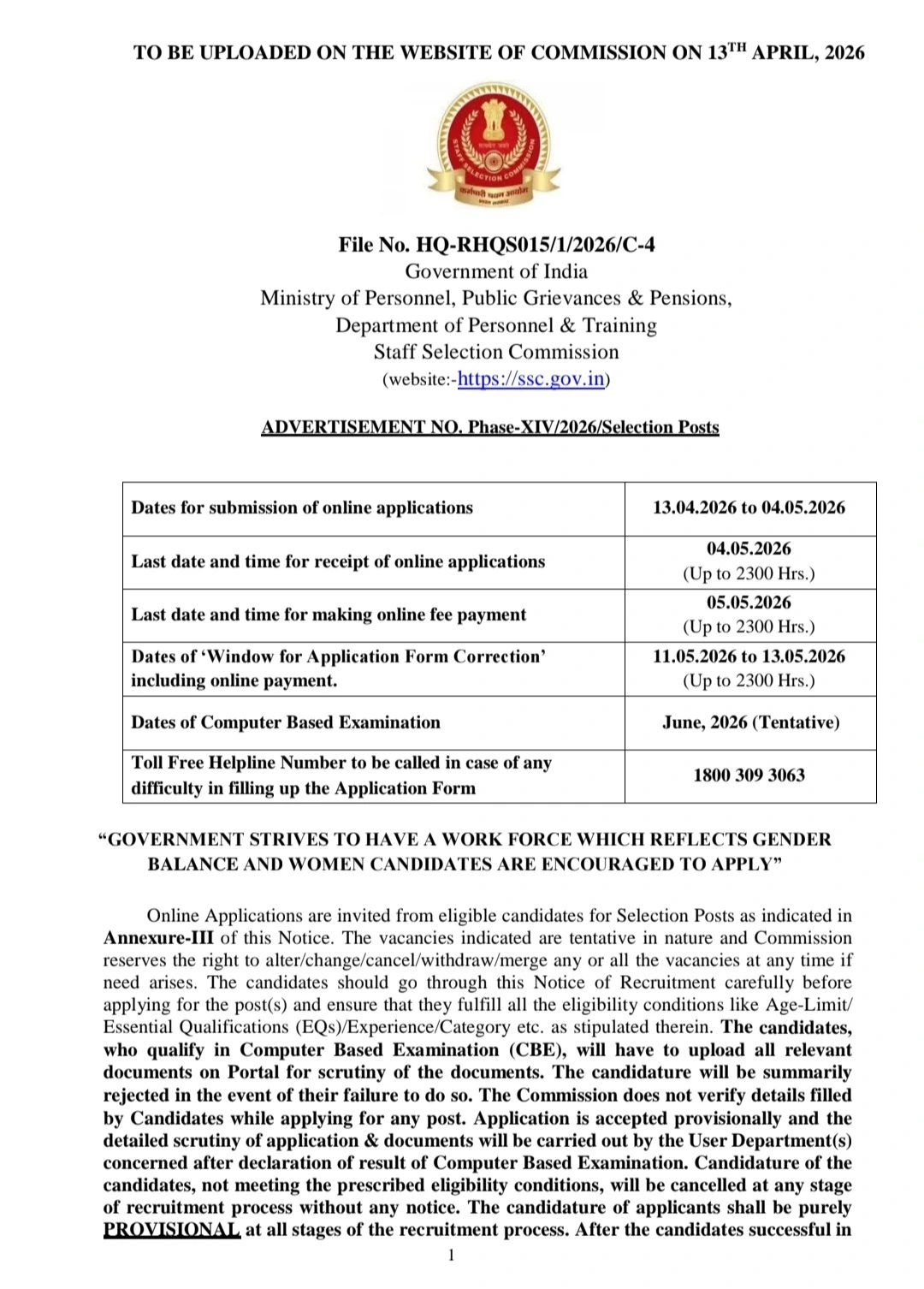

The SSC Selection Post Phase 14 Recruitment 2026 has opened a major opportunity for candidates looking for central government jobs. With 3003 vacancies announced through the Staff Selection Commission, this recruitment covers posts for 10th pass, 12th pass, and graduate candidates, making it one of the broadest recruitment drives of the year.
What makes this recruitment especially attractive is its reach. Whether you are a first-time applicant or someone preparing for government jobs for years, this notification offers a practical route into ministries, departments, and government offices across India.
The online application process began on 13 April 2026 and candidates can apply until 4 May 2026. Since the exam is expected in June 2026, this is also the right time to start preparation seriously.
What Is SSC Selection Post Recruitment?
Unlike single-post exams, the SSC Selection Post recruitment is designed to fill multiple categories of posts under one examination system. Instead of applying separately for different departments, candidates apply through one process and compete for posts matching their qualification level.
At the matriculation level, vacancies may include support and clerical roles. At the higher secondary level, opportunities expand into assistant and technical support posts. For graduates, the range becomes even wider, including inspector, assistant, research, and administrative posts.
That is why this recruitment remains popular year after year. It does not target only one group of candidates. It opens doors at multiple education levels.
Vacancy Details
This year, 3003 posts have been announced. The highest number of vacancies fall in the Unreserved category, followed by OBC, SC, EWS, and ST categories.
Compared with previous phases, this year’s recruitment shows healthy vacancy growth, which often increases candidate interest and competition.
Important Dates
Candidates should keep the schedule in mind because missing deadlines can end the opportunity before the exam even begins.
The online application closes on 4 May 2026, while fee payment remains open until 5 May 2026. There is also a correction window from 11 to 13 May, which allows limited edits if mistakes are discovered after submission.
The Computer-Based Exam is expected in June 2026.
Eligibility Criteria
One reason this recruitment attracts millions is its inclusive eligibility structure.
If you have passed Class 10, you may be eligible for matric-level posts.
If you have passed 12th, you can apply for higher secondary level posts.
If you hold a bachelor’s degree, you may apply for graduate-level posts.
Age limits vary by post, generally ranging between 18 and 35 years, with relaxation available for reserved categories as per government norms.
Because age and qualification requirements differ from post to post, candidates should always verify the specific post they select while filling the application.
Application Fee
The fee remains affordable. General and OBC candidates pay ₹100, while women candidates and candidates from SC, ST, PwBD, and Ex-Servicemen categories are exempt from fee payment.
That keeps the barrier to entry low, which is one reason participation remains massive every year.
How the Selection Process Works
The recruitment process is straightforward because selection is based mainly on the Computer-Based Examination.
There is no interview for most posts, which many candidates consider a major advantage.
For certain posts, skill tests such as typing or data entry may apply, but those are generally qualifying in nature and do not usually add marks to the final merit.
That means your written exam performance matters most.
Exam Pattern
The exam consists of four equal sections:
General Intelligence
General Awareness
Quantitative Aptitude
English Language
Each section carries equal weight, which means ignoring one subject can be risky.
There is negative marking of 0.50 marks for wrong answers, so accuracy matters just as much as speed.
Candidates often make the mistake of focusing only on reasoning and quant while neglecting English or General Awareness. That approach can be costly because all four sections contribute equally.
Syllabus Overview
Preparation should begin with the core topics.
Reasoning includes puzzles, coding, ranking, directions, and analytical logic.
General Awareness covers current affairs, static GK, awards, history, geography, and government schemes.
Quantitative Aptitude focuses on arithmetic fundamentals such as percentages, profit and loss, ratio, time and work, and data interpretation.
English covers grammar, comprehension, vocabulary, and sentence correction.
The syllabus is broad, but predictable. That makes disciplined preparation effective.
Salary and Career Growth
One of the strongest reasons candidates target this exam is the salary structure combined with long-term job security.
Posts under this recruitment fall across Pay Levels 1 to 7, with basic pay ranging from lower clerical scales to much stronger technical and administrative levels depending on the post.
Beyond salary, candidates may receive allowances such as DA, HRA, and transport benefits, which increase overall earnings.
More importantly, these are central government roles, which carry promotion opportunities, stability, and pension-linked long-term value.
Why This Recruitment Matters
Many government exams are restricted by degree, age, or specialization.
This one is different.
It gives opportunities to candidates at three education levels, covers thousands of posts, has a direct exam-based selection process, and offers access to central government employment without an interview barrier in most cases.
That combination is rare.